
UTM Monitoring
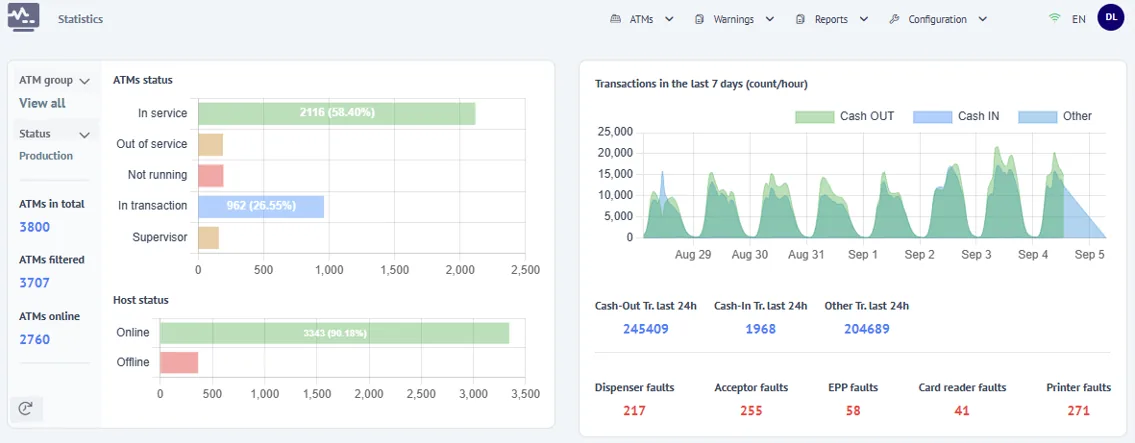
UTM Monitoring is a system for monitoring and management of the bank's ATM network. It collects technical data from ATMs and terminals, shows the state of the whole network in real time and helps operators find the cause of failures and eliminate them remotely. The system is multi-vendor and works regardless of the ATM model and of the application software installed on the ATM.
Architecture
The system consists of an agent on the ATM and a server part installed in the bank's infrastructure. No cloud or external services are used, all data remain inside the bank. The agent does not interfere with the ATM software: it collects data and opens XFS sessions only when a command requires it. The system works over unstable communication channels with low bandwidth and is designed for networks of 10,000 ATMs and more. The server runs on Linux (Ubuntu or Red Hat) with a PostgreSQL database.
ATM status and diagnostics
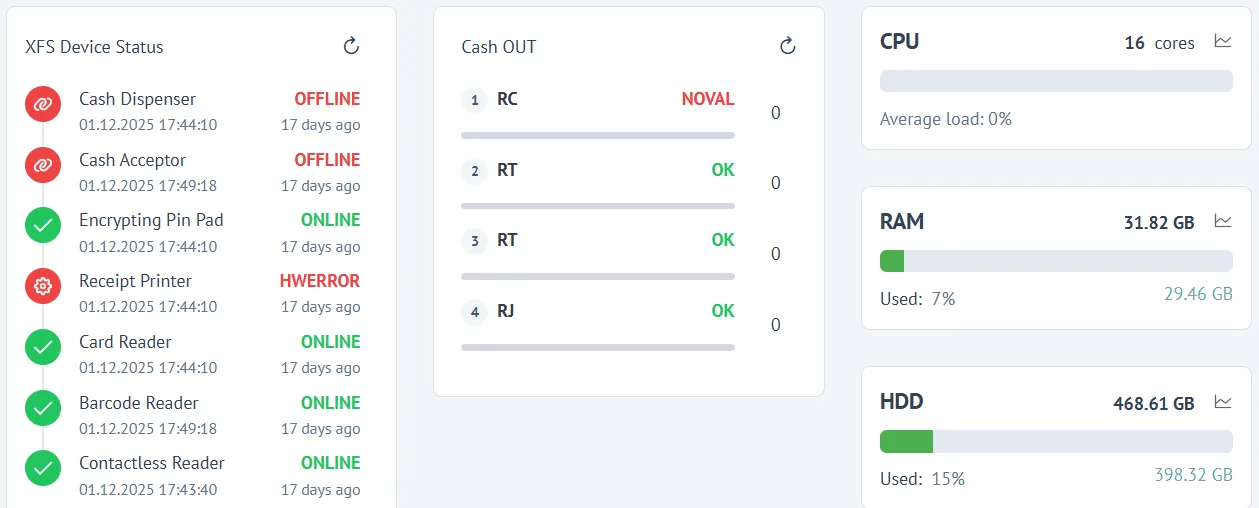
For each ATM the operator sees the status of all devices, cassette counters, hardware and software inventory, firmware versions and the event log. Events from XFS, NDC, the electronic journal, the operating system and device drivers are collected in one place. The device status timeline with error codes and detailed XFS data helps to identify chronic errors and intermittent device failures and to investigate customer claims.
Remote management
Commands are sent to a single ATM or to a group of ATMs: error reset, put in service or out of service, reboot, screenshot and live view of the screen, script execution. Files are transferred to and from the ATM by drag and drop. Software packages are distributed to groups of devices, and unexpected changes of software versions are logged and reported.
Incidents and cash
When a specified event occurs, the system creates a service call with diagnostic data, assigns it to a bank department or an external service provider and tracks its execution. Cash monitoring shows the cassette levels and helps to plan replenishment. Integration with service desk and other external systems is available via API.
Basic functions
- Real-time dashboards: availability, failure rate, downtime, transaction load
- ATM map
- Alerts and notifications by configurable rules
- KPI calculation, customizable reports and formulas
- Cash level monitoring and alerts
- Incident management with SLA control
- Software distribution and version control
- Role-based access and user hierarchies